China is Qatar’s most important trade partner. In early 2026, China was the largest source of goods coming into Qatar, at roughly 18% of all imports. It was also the top buyer of Qatari exports. Vehicles, electronics, building materials, furniture and everyday consumer goods all depend on the China–Qatar supply chain.
In 2026, that supply chain changed more than at any time in the last decade. The reason is the Strait of Hormuz.
The Strait of Hormuz Crisis: A Quick Summary
The Strait of Hormuz is the narrow waterway between Iran and Oman. It connects the Arabian Gulf to the open ocean. Almost every container ship sailing from China to Hamad Port has historically passed through it.
In 2026, regional conflict turned Hormuz into the world’s most dangerous shipping lane:
A preliminary US–Iran agreement in mid-June raised hopes. Days later, Iran declared the strait closed again. Attacks on commercial vessels have continued into autumn, and maritime intelligence firms rate the threat to shipping as severe. Traffic has collapsed. On some days, only one or two vessels cross, compared with roughly 85 per day before the crisis. Major Chinese shipping lines have kept many of their vessels out of Hormuz and the Red Sea. Diplomacy continues, with Qatar itself acting as a mediator. However, no lasting reopening has been agreed.
What Changed for China–Qatar Imports
1. New shipping routes into Qatar
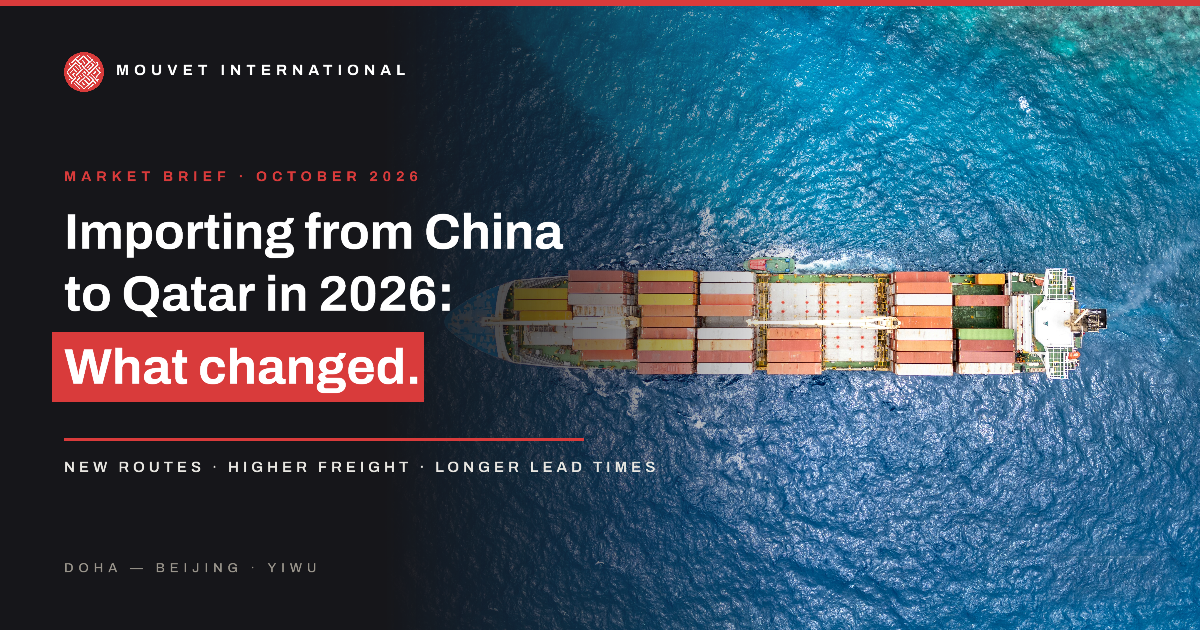
Cargo from China no longer sails straight into Doha. Carriers now use multimodal routes. Ships unload at ports outside the Gulf, such as Oman’s ports, the UAE’s east coast (Khor Fakkan and Fujairah) or Jeddah on the Red Sea. From there, goods move by truck across Saudi Arabia, or by short feeder vessels, to reach Qatar.
2. Higher freight costs and surcharges
These alternative routes are slower, more expensive and limited in capacity. Expect war-risk surcharges, higher fuel (bunker) costs, and land-transport fees on top of ocean freight.
3. Longer and less predictable lead times
Extra handling and congested land borders add days or weeks to delivery. Fixed delivery dates have become harder to guarantee.
4. Strong demand, constrained supply
Qatar’s demand for Chinese goods remains resilient, while capacity into the Gulf is limited. Importers who plan ahead secure space. Importers who wait pay more.
What It Means for Qatari Businesses
The China–Qatar trade relationship is not weakening. It is adapting. For importers, retailers, contractors and e-commerce sellers in Qatar, the new reality means:
Plan orders earlier. Add a buffer of several weeks to your usual lead time. Budget for landed cost, not just the factory price. Freight, surcharges and land transport now make up a larger share of the total. Consolidate shipments. Combining orders from multiple Chinese suppliers into one container reduces cost per unit. Verify suppliers on the ground. With longer transit times, a defective shipment costs far more to fix. Inspections before loading matter more than ever. Stay flexible on routing. The fastest route this month may not be the fastest next month.
The Long-Term Outlook for China–Qatar Trade
Gulf governments are investing heavily in alternatives to Hormuz. These include expanded Red Sea and Omani port links and the planned GCC Railway, a 2,186 km network designed to connect Qatar overland to Saudi Arabia, the UAE and Oman. Whether Hormuz reopens soon or not, Qatar’s import supply chain is becoming more diversified, and this is a structural shift.
For businesses that source from China, the lesson of 2026 is clear. Success depends on having a reliable sourcing partner on both ends of the route.
How Mouvet International Helps
Mouvet International is a China–Qatar sourcing company with teams in Yiwu, Beijing and Doha. We help Qatari businesses source products from China, verify factories, inspect quality, consolidate orders and manage shipping through today’s alternative routes, from the factory floor to your door in Qatar.